Average Reviews:

(More customer reviews)I'm just not very good at extrapolating distances from yard markers or marked sprinkler heads (if you can find them). Both my score and frustration was on the rise because I was misjudging the distances and choosing the wrong club. So I decided to buy a GPS Caddie.
I chose a GPS range finder over a laser device. The latter requires a clear line of sight to the pin, which isn't always possible. On the other hand, A GPS unit simply measures the distance from wherever you're standing to the points you wish to map. Also, you can map hazards as well as other landmarks. All you need is a clear shot at the sky.
Here's why I recommend the GPS Caddie.
It's one of the cheapest on the market, and you can map up to eight custom points in addition to the front, center and back of the green. It's comforting to know the precise distance to the middle of a bend on a dogleg, or the end of the fairway, or a blind hazard, and so on. I haven't found a need yet to map more than four or five points--but it's nice to know you can.
Once you get the knack of it, you can map a course in about 90 minutes, faster if you don't map a lot of custom points. All you have to do is stand at a point you want to map, push a button, wait a few seconds, and--voila--it's done. Then you save it and move on. The process is pretty simple, and the instructions are easy to follow.
iGolf, the manufacturer, also provides a web site, which enables you to download previously mapped courses from their files, and they will even map a course for you at a nominal fee. But, unlike many other GPS units, the GPS Caddie is completely self-contained. You don't need a computer, although it is recommended you back up the courses you have mapped. (Once you've mapped five or six courses, you will have invested considerable time and effort.)
The GPS Caddie also offers another neat feature--a way to measure the distance of your shots. All you have to do is punch a button from, say, the tee box, and punch it again at your ball, and it will tell you the distance of your drive. And you can walk over to your partner's ball, and measure that distance, too. In fact, you can measure any distance from Point A to Point B.
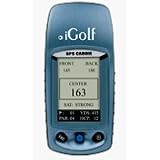
The GPS Caddie is a no-frills GPS range finder that offers no graphics, just large, clear numbers, which are accurate to ten feet or less (mostly less). The screen provides the hole number, par, yardage, and handicap. And, of course, the distance to the front, center and back of the green, and other points if you've mapped them. Some more expensive units provide colors and flashy graphics, but I don't feel a bit deprived.
The unit seems durable, and fits one's palm very nicely. The non-slip edging adds a sturdy feel, and after taking it through a heavy downpour with out any problems, I have to say the unit is at least "water resistant."
Using a GPS range finder adds a pleasant new dimension to playing golf. It speeds up the game, removes the distance-guessing angst in selecting the appropriate club. Instead, you can focus on executing rather than navigating. You save the time you'd spend having to extrapolate distances from yard markers, sprinkler heads, trees, etc. This is especially helpful for shots within 100 yards, where most courses provide few--if any--distance markers.
Frankly, I was a bit reluctant to spend a couple of hundred bucks on a range finder. But now, after using it for several weeks, I'd hate to give it up. It has made golfing more fun, boosted my confidence, and eliminated some extraneous swing thoughts. And the GPS Caddie has saved me three or four strokes.
Moreover--considering my high-handicap game--it's nice to have my partner ask me a question for a change, even if it's only the distance to the green.
Click Here to see more reviews about: Igolf Gps Caddie Requires 2 Aa Batteries

Click here for more information about Igolf Gps Caddie Requires 2 Aa Batteries

0 comments:
Post a Comment